
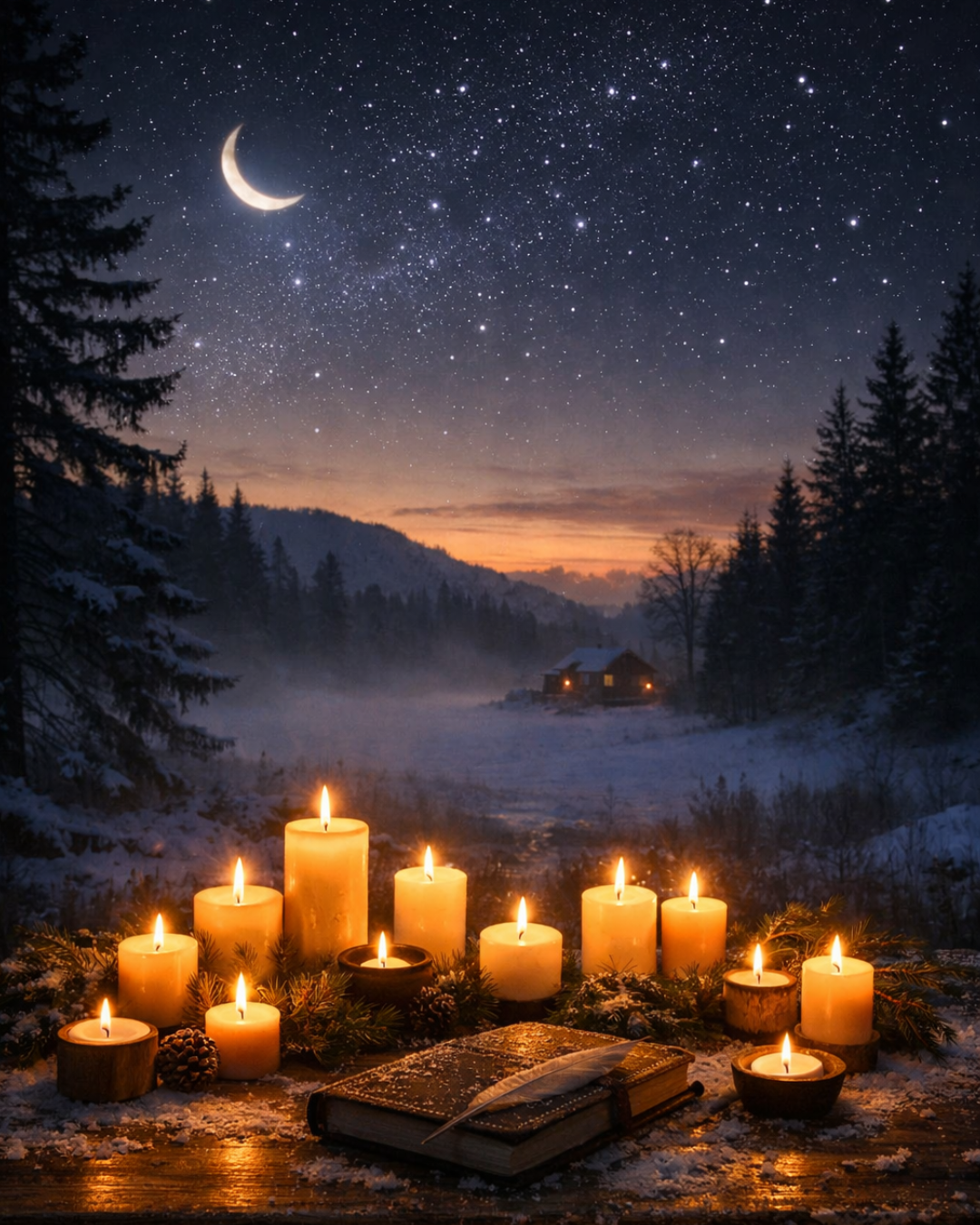
There is a space in the year that does not belong to endings or beginnings.
It lives between the longest night and the slow return of the light — a liminal stretch where time feels suspended, where the world exhales, and where reflection comes more naturally than resolution.
This is the Twelve Nights of Yule.
Traditionally, these nights mark the days between the Winter Solstice and the New Year — a threshold space where the old year loosens its grip and the new one has not yet fully arrived. In many earth-based traditions, this time was honoured not with productivity or planning, but with rest, storytelling, remembering, and quiet observation.
A season outside of time.
This year, that feels especially fitting.
The year behind me was not loud or linear. It asked for patience. For listening. For surrendering control when my body could no longer carry me the way it once had. There were months of uncertainty, healing, and learning how to stay present without rushing toward what came next.
Yule met me there — not as a celebration, but as permission.
Permission to stop performing joy.
Permission to honour darkness without fearing it.
Permission to acknowledge that survival itself can be sacred.
The Twelve Nights offer a gentle rhythm for this kind of reflection. Each night becomes a soft doorway — not demanding answers, but inviting honesty. They are not about fixing the past year or setting intentions with force. They are about witnessing what has already shaped us.
For me, these nights echo the arc of the year I lived.
There was the weight I carried without fully understanding it.
The body that asked for care instead of endurance.
The choice to keep going — sometimes through motion, sometimes through stillness.
The pause that came with healing.
The unexpected creation that arrived in quiet hours.
The courage to let myself be seen.
The slow return of hope.
None of it happened all at once. And none of it needs to be wrapped neatly.
That is the gift of this season.
The Twelve Nights do not ask us to rush into becoming someone new. They ask us to sit with who we already are — shaped by the year we have just lived. They honour the truth that light does not return suddenly or dramatically, but gradually, faithfully, in its own time.
And perhaps that is the most comforting part.
If you feel drawn to this season, approach the Twelve Nights gently. Not as a ritual to perform correctly, but as a quiet practice of noticing. A candle. A few moments of stillness. A willingness to listen inwardly is enough.
You don’t need answers right away. Some questions are meant to be lived into.
Below is a simple reflection for each night — not as instruction, but as an invitation.
The Twelve Nights of Yule
Night One — Weight
What did I carry that deserves to be set down?
Night Two — Body
Where did my body ask for care instead of pushing?
Night Three — Choice
When did I choose to keep going, even quietly?
Night Four — Stillness
What changed when I was forced to slow down?
Night Five — Creation
What was born in the quiet?
Night Six — Courage
Where did I allow myself to be seen?
Night Seven — Endurance
What did I survive that deserves honour?
Night Eight — Support
Who or what held me when I couldn’t hold myself?
Night Nine — Release
What version of myself am I ready to let go of?
Night Ten — Gratitude
What carried me through, even unnoticed?
Night Eleven — Light
Where is the smallest sign of return?
Night Twelve — Blessing
What do I gently carry forward?
As the Wheel turns and the light begins its slow return, may you honour the year that shaped you — not with judgment, but with compassion. May you trust that what feels unfinished is simply still unfolding.
The Twelve Nights remind us that we are allowed to pause.
That darkness is not a failure.
And that even the smallest returning light is enough.