
I grew up in a house where Christmas didn’t just arrive — it revealed itself, slowly and tenderly, like a secret that only the walls knew how to hold. My parents, both German immigrants, carried their childhoods with them across an ocean, without ever realising how much of what they brought was rooted in something ancient. Something older than any church tower or carol. Something that lived in the land, in the seasons, in the bones of the people who came before us.
They didn’t know they were practising old pagan traditions. They weren’t trying to. They were simply doing what their parents had done, and what their grandparents had done, the way families do when they don’t realise they’re passing down a quiet kind of magic.
One particular December, when I was small, in the same farmhouse that later inspired my novel Through Bright Eyes, the living room became forbidden territory. A curtain pulled tight, like an invitation and a warning all at once. In true German fashion, the tree itself was hidden from us — a tradition where the Christkind or Weihnachtsmann would “bring” the decorated tree, so children only saw it when it was truly ready, candles lit and magic in full bloom. My siblings and I tried to peek underneath that curtain, always hoping for just a glimpse of a branch, a glimmer of tinsel, anything — but the mystery never cracked. My mother protected it with a seriousness that I understand now: some things become more sacred when they’re hidden.
Christmas Eve — not Christmas Day — was the moment everything unfurled. The air tasted different that day. Thicker, sweeter, humming with anticipation. Before we were allowed to enter the room, we had to stand in front of that curtain and either recite a poem or sing a song, our small voices trembling more from excitement than nerves. We performed for entry into the magic, and somehow it made everything feel like a ritual, even though none of us had language for “ritual” back then.
And then… the curtain opened.
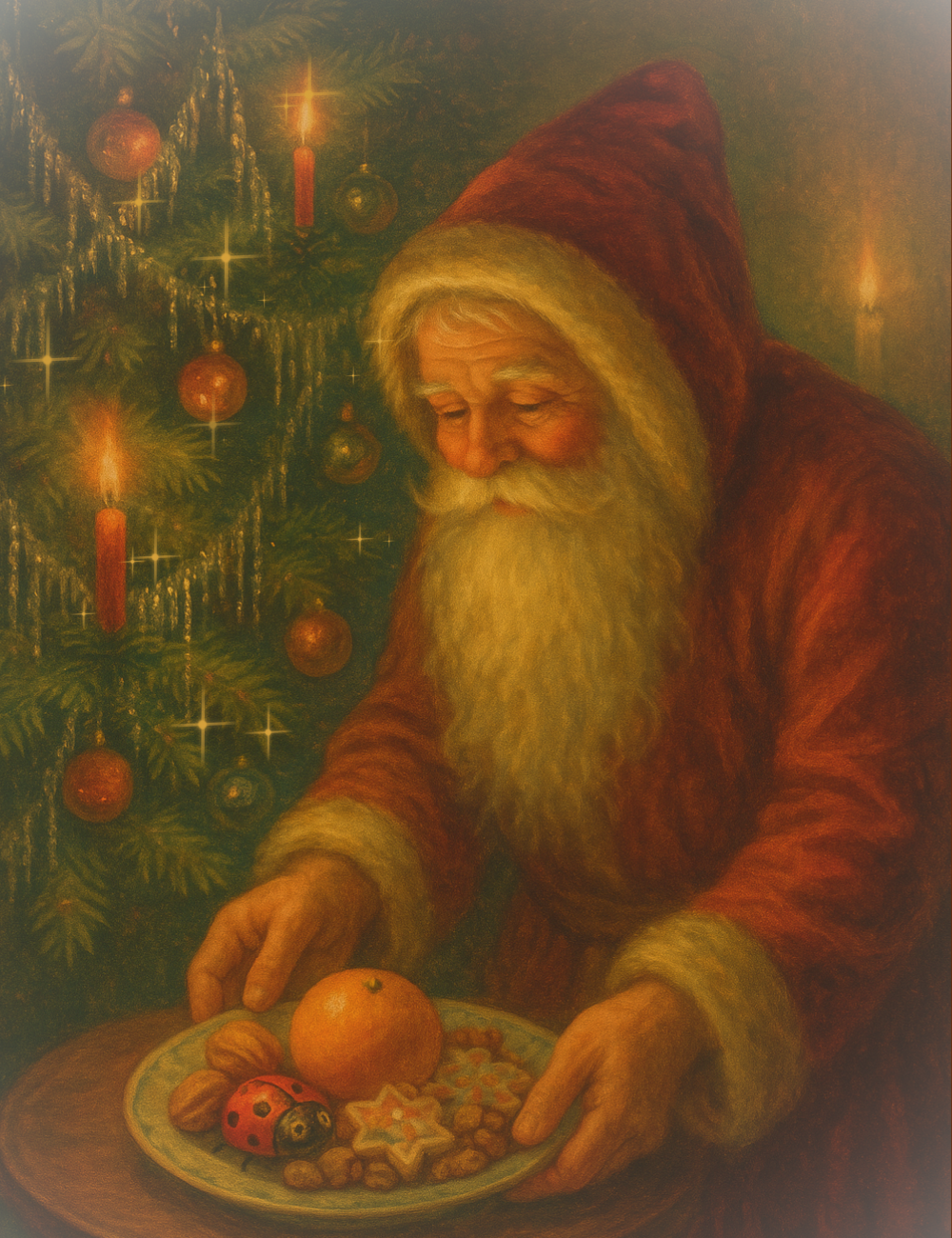
There are very few moments in adulthood that can compare to what lived in that split second — when the world shifted, softened, and glowed. In the centre of the room stood a Norman fir that looked like it had stepped out of a dream, wrapped in strands of silver tinsel that shimmered like frost. And the candles — the real candles — flickered on the branches like tiny stars. No plastic bulbs, no safe little flames. These were living candles, breathing candles, each one trembling with the tiniest whisper of heat and light.
Even as a child, I felt something swell behind my ribs. A safety. A knowing. A feeling that I was standing inside something far older than me, far older than all of us.
At the foot of the tree waited the Bunte Teller, the colourful plates my mother assembled as though she were preparing offerings for a goddess she didn’t know she believed in. Oranges and tangerines, walnuts and hazelnuts, chocolate ladybugs wrapped in shiny foil, marzipan, Christmas cookies dusted with sugar. At the time, I only tasted sweetness. Now I see symbolism:
Oranges and tangerines — tiny suns in the middle of winter, symbols of the returning light.
Nuts — seeds of new beginnings, potential hidden in hard shells.
Sweet treats — reminders that joy still exists even in the darkest season.
Ladybugs — little guardians of luck and protection.
Marzipan — abundance, prosperity, and the softness of celebration.
My mother placed each piece with a kind of quiet devotion, though she would never have called it that. She didn’t need to. Devotion doesn’t require a name.
As I got older, I began to understand what my body had known long before my mind did: we weren’t just celebrating Christmas. We were participating in something far more ancient — something woven into the roots of European pagan traditions that Christianity later layered itself over. Not erased. Not replaced. Just covered, like soft snow on an old path.
And even though the true Winter Solstice — Yule — falls a little earlier, usually around December 21st or 22nd, our celebration on December 24th carried its spirit just the same. In so many German families, the old solstice traditions simply slipped into Heiligabend, the way roots slip beneath snow. So even if the date wasn’t exact, the essence was there — the candles, the evergreen, the offerings of fruit and nuts, the gathering in the dark to welcome the returning light. We were, without knowing it, celebrating Yule in our own way.
Yule became Christmas.
Samhain was followed by All Saints’ Day.
Ostara and its eggs and rabbits became Easter.
Season after season, the festivals of earth and sun and moon simply changed their names, not their essence.
But this isn’t something I reflect on with bitterness or blame.
If anything, learning these things softened me.
It made me feel connected — to my ancestors, to the land, to people who lived and loved and feared the long winter just as we do.
Because when you strip away all the labels and doctrines, humans have always celebrated the same things:
The return of the sun.
The fear of darkness.
The hunger for warmth.
The need to gather.
The longing for connection.
The hope for renewal.
The belief that light will always find its way back.
Christmas was never about gifts, It was about that moment — when the curtain opened and everything glowed. It was about the ache in my chest when the candles flickered against the tinsel. About the scent of oranges and pine mingling like a prayer. About the understanding, even as a child, that we were marking the turning of the year — the slow loosening of winter’s grip, the promise that brighter days were coming.
As an adult, I still feel that ache every December. That longing. That instinct to draw inward, to slow down, to reflect and cocoon and dream. To make plans for the coming light while still honouring the quiet of the dark. We think of winter as an ending, but it’s also a beginning. A womb. A time when everything sleeps in order to be reborn.
And maybe that’s the real truth of why we celebrate this time of year — not because of any one religion or story, but because we’re human. Because deep in our bones, we remember the old ways. Because we crave warmth, connection, magic, and meaning. Because we’re part of a much bigger picture than we realise.
Every December, when the days shrink and the nights stretch long, I find myself standing at that curtain again — breath held, heart open — waiting for the moment the world glows. And it always does.
The old magic is still here.
It never left.
It just waits for us to remember. <3