• Thea Marie Art - Welcome
  • About
  • Through Bright Eyes - Book 1
  • Whispers Through the Veil Series - Purchase Books
  • Blog - An Artists Life
  • Custom Orders
  • Journey Uphill - A Bike Ride to Remember
  • Current Works
  • Past Works
  • Step-by-Step
  • Volunteer Work
  • Commissions
  • Photography
  • Studies
  • Contact
  • Copyright
  • Menu

Thea Marie Art

...through the prism of my senses I create
  • Thea Marie Art - Welcome
  • About
  • Through Bright Eyes - Book 1
  • Whispers Through the Veil Series - Purchase Books
  • Blog - An Artists Life
  • Custom Orders
  • Journey Uphill - A Bike Ride to Remember
  • Current Works
  • Past Works
  • Step-by-Step
  • Volunteer Work
  • Commissions
  • Photography
  • Studies
  • Contact
  • Copyright

Kindling the Heart: A Yule and Christmas Meditation

December 12, 2025

I grew up in a house where Christmas didn’t just arrive — it revealed itself, slowly and tenderly, like a secret that only the walls knew how to hold. My parents, both German immigrants, carried their childhoods with them across an ocean, without ever realising how much of what they brought was rooted in something ancient. Something older than any church tower or carol. Something that lived in the land, in the seasons, in the bones of the people who came before us.

They didn’t know they were practising old pagan traditions. They weren’t trying to. They were simply doing what their parents had done, and what their grandparents had done, the way families do when they don’t realise they’re passing down a quiet kind of magic.

One particular December, when I was small, in the same farmhouse that later inspired my novel Through Bright Eyes, the living room became forbidden territory. A curtain pulled tight, like an invitation and a warning all at once. In true German fashion, the tree itself was hidden from us — a tradition where the Christkind or Weihnachtsmann would “bring” the decorated tree, so children only saw it when it was truly ready, candles lit and magic in full bloom. My siblings and I tried to peek underneath that curtain, always hoping for just a glimpse of a branch, a glimmer of tinsel, anything — but the mystery never cracked. My mother protected it with a seriousness that I understand now: some things become more sacred when they’re hidden.

Christmas Eve — not Christmas Day — was the moment everything unfurled. The air tasted different that day. Thicker, sweeter, humming with anticipation. Before we were allowed to enter the room, we had to stand in front of that curtain and either recite a poem or sing a song, our small voices trembling more from excitement than nerves. We performed for entry into the magic, and somehow it made everything feel like a ritual, even though none of us had language for “ritual” back then.

And then… the curtain opened.

There are very few moments in adulthood that can compare to what lived in that split second — when the world shifted, softened, and glowed. In the centre of the room stood a Norman fir that looked like it had stepped out of a dream, wrapped in strands of silver tinsel that shimmered like frost. And the candles — the real candles — flickered on the branches like tiny stars. No plastic bulbs, no safe little flames. These were living candles, breathing candles, each one trembling with the tiniest whisper of heat and light.

Even as a child, I felt something swell behind my ribs. A safety. A knowing. A feeling that I was standing inside something far older than me, far older than all of us.

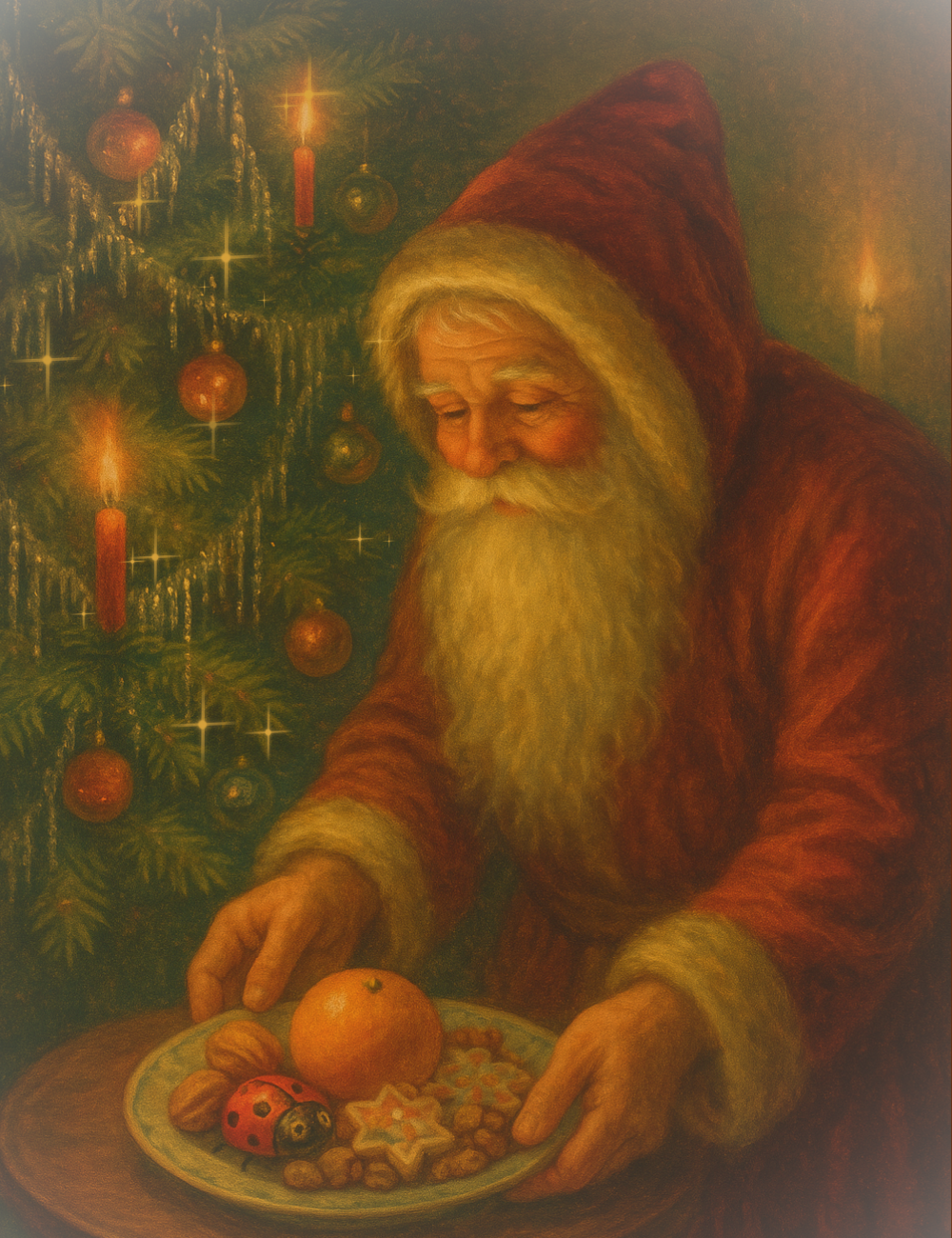
At the foot of the tree waited the Bunte Teller, the colourful plates my mother assembled as though she were preparing offerings for a goddess she didn’t know she believed in. Oranges and tangerines, walnuts and hazelnuts, chocolate ladybugs wrapped in shiny foil, marzipan, Christmas cookies dusted with sugar. At the time, I only tasted sweetness. Now I see symbolism:

Oranges and tangerines — tiny suns in the middle of winter, symbols of the returning light.
Nuts — seeds of new beginnings, potential hidden in hard shells.
Sweet treats — reminders that joy still exists even in the darkest season.
Ladybugs — little guardians of luck and protection.
Marzipan — abundance, prosperity, and the softness of celebration.

My mother placed each piece with a kind of quiet devotion, though she would never have called it that. She didn’t need to. Devotion doesn’t require a name.

As I got older, I began to understand what my body had known long before my mind did: we weren’t just celebrating Christmas. We were participating in something far more ancient — something woven into the roots of European pagan traditions that Christianity later layered itself over. Not erased. Not replaced. Just covered, like soft snow on an old path.

And even though the true Winter Solstice — Yule — falls a little earlier, usually around December 21st or 22nd, our celebration on December 24th carried its spirit just the same. In so many German families, the old solstice traditions simply slipped into Heiligabend, the way roots slip beneath snow. So even if the date wasn’t exact, the essence was there — the candles, the evergreen, the offerings of fruit and nuts, the gathering in the dark to welcome the returning light. We were, without knowing it, celebrating Yule in our own way.

Yule became Christmas.
Samhain was followed by All Saints’ Day.
Ostara and its eggs and rabbits became Easter.
Season after season, the festivals of earth and sun and moon simply changed their names, not their essence.

But this isn’t something I reflect on with bitterness or blame.
If anything, learning these things softened me.
It made me feel connected — to my ancestors, to the land, to people who lived and loved and feared the long winter just as we do.

Because when you strip away all the labels and doctrines, humans have always celebrated the same things:

The return of the sun.
The fear of darkness.
The hunger for warmth.
The need to gather.
The longing for connection.
The hope for renewal.
The belief that light will always find its way back.

Christmas was never about gifts, It was about that moment — when the curtain opened and everything glowed. It was about the ache in my chest when the candles flickered against the tinsel. About the scent of oranges and pine mingling like a prayer. About the understanding, even as a child, that we were marking the turning of the year — the slow loosening of winter’s grip, the promise that brighter days were coming.

As an adult, I still feel that ache every December. That longing. That instinct to draw inward, to slow down, to reflect and cocoon and dream. To make plans for the coming light while still honouring the quiet of the dark. We think of winter as an ending, but it’s also a beginning. A womb. A time when everything sleeps in order to be reborn.

And maybe that’s the real truth of why we celebrate this time of year — not because of any one religion or story, but because we’re human. Because deep in our bones, we remember the old ways. Because we crave warmth, connection, magic, and meaning. Because we’re part of a much bigger picture than we realise.

Every December, when the days shrink and the nights stretch long, I find myself standing at that curtain again — breath held, heart open — waiting for the moment the world glows. And it always does.

The old magic is still here.
It never left.
It just waits for us to remember. <3

Seven Days to Fifty - A Life in Storyform

November 29, 2025

Outside, the storm has begun.

I’m sitting at my kitchen table, watching through the back patio doors as the first true snow of the season drifts into my yard. The trees have slipped into their winter coats overnight, branches holding the fresh white as if they’ve been waiting all year for this quiet transformation. Behind the house, the pond trembles at its edges — not yet frozen, but no longer fully free. Everything seems to hover in that delicate space between what it once was and whatever it is becoming next.

My feathered friends gather in the fading light, hopping and fluttering with purpose as they fill themselves before the night settles in. They sense the change long before I do. Nature never negotiates with the seasons; it simply adjusts and carries on. And as I watch the storm gather itself over the yard, I feel a similar stillness settling inside me — a quiet pause, a moment of reflection as the countdown to my fiftieth birthday begins.

Seven days until fifty.
Half a century.
A milestone I was never entirely certain I would reach.

It feels fitting that this reflection comes now, in the hush of early winter, when the nights are long, and memory rises gently to the surface. This season seems designed for looking back — not with regret or longing, but with a kind of knowing. The air itself feels wiser.

When I look back at the beginning of my life, what I remember first is wonder. I was born on St. Nicholas Day, December 6th — a day wrapped in old European traditions where children left their shoes by the door overnight, hoping to wake to sweets instead of coal. My mom always said this was the origin of Christmas stockings. Whether she was right or not never mattered to me; I loved the symbolism. Shoes waiting in the dark. Magic or mischief. Blessing or warning. A tiny ritual that mirrors the unpredictability of a whole lifetime.

And in those early years, my life did feel charmed. Two creative parents, siblings who loved me in their own unique ways, and a home filled with imagination, laughter, and the feeling of being held safely in the centre of something warm. My first five years were golden — soft-edged, storybook-bright, lit from within.

Then came that night on the farmhouse road—the moment that marked the fracture line in my life.
The before… and the after—the very moment where everything warped into something new.
Not because of the darkness itself, but because of what waited inside it.

That pivotal night, my mom and I found a hitchhiker left for dead on the frigid, snow-covered shoulder of our gravel farmhouse road. I knew her name once. Now that my mom is gone, that truth may remain lost forever. But this woman, she became the seed for the fictional Margaret Benson in my book — a character shaped from the shadow of a real woman’s suffering, whose presence imprinted itself on my childhood in ways I’m still trying to understand. That night was my first encounter with the darker side of the world, the side that doesn’t always hand you sweetness. Sometimes it hands you coal, sharp and unyielding, and expects you to figure out how to carry it.

From that point on, life unfolded in ways no child should have to navigate: abandonment, trauma, violence, alcohol abuse, and the silent ache of growing up too quickly. Those experiences arrived faster than I could process them, bewildering and heavy, shaping my beliefs about myself and about the world before I even had the language to explain them.

But as I sit here now — fifty shimmering on the horizon — I find that I can look back with a kind of gentleness I never imagined possible. I can trace the shape of my life without flinching. Every experience, both grace-filled and gutting, formed some part of who I became. And if you want to call it luck, or divine protection, or sheer stubborn spirit — something carried me when I couldn’t carry myself. Something whispered, Not yet. You still have chapters left to live.

It was difficult growing up with a mother who struggled with deep depression and anxiety. I learned very early that life was fragile. And out of that belief, I believed I would never grow old. I didn’t imagine myself ever reaching this age. Longevity felt like something meant for other people — people who hadn’t lived the sort of life I had.

But this past year changed everything.

After surviving decades of trauma, biking 600 kilometres on a broken hip, recovering from yet another major surgery, healing myself inside and out, writing a debut novel and beginning the second— I finally realised the story I’d carried about myself was outdated.

I wasn’t weak.
I wasn’t fragile.
I was resilient in ways I had never been allowed—or allowed myself—to recognise.

My life didn’t break me.
It carved me into someone intuitive, creative, perceptive, and impossibly determined to keep going. Someone who now understands that surviving is its own kind of brilliance.

As I plan the final details of my birthday celebration, I’m struck by how different I feel from the girl who once assumed she wouldn’t live long. I am healthier, happier, and more grounded than I have ever been — not just in my body, but in my mind and spirit. It feels as though I have stepped out of an old identity and into a new one, filled with clarity and steadiness.

And perhaps that is why winter feels so symbolic to me now.

St. Nicholas Day doesn’t just welcome gifts; it welcomes the season of stillness — the quiet weeks when the world settles and prepares for transformation. Winter is often mistaken for an ending, but I’ve come to see it as a beginning. A necessary pause. A deep breath before life blooms again.

Maybe it’s no coincidence that I was born in a season that asks us to slow down and listen closely.

My life has been a mixture of winter and wonder, coal and chocolate, shadow and spark. I’ve known the cold, but I’ve learned to kindle my own warmth — not the warmth borrowed from circumstance, but the kind built through resilience, introspection, and courage.

So as I step into my fiftieth year, I feel like a winter child preparing for spring — a woman who has weathered storms and come out luminous on the other side, finally aware of her own light.

And as I dance my way into my 51st year, I carry a deep gratitude for every person who has walked beside me, supported me, challenged me, loved me, or simply stayed when life became difficult. And for all those I have yet to meet — the ones who will step into the next chapters with me — I welcome you with an open heart.

Life has handed me both chocolate and coal.
Somehow, I learned to turn them into something beautiful.

Even in winter,
I rise warm. <3

Samhain Reflections - Coming Home to Myself

November 01, 2025

Jack-o’-lanterns glow along the quiet streets, their light trembling in the wind. The veil softens. The air carries that ancient hush — the kind that makes you pause and listen. Samhain, the witches’ new year, arrives like the tide: drawing in what was, and pulling us gently toward what will be.

This year, it feels different. This year, it feels like I have crossed a threshold — not just of time, but of soul. I have stepped into the full current of who I am: creative, raw, alive. The one who waited in the undertow, whispering for me to return.

It wasn’t an easy crossing. The road here curved through fire and stillness — through the freedom of my summer ride, the birth of my novel, and the long, humbling rhythm of healing after surgery. Each experience rose and fell like a wave, carrying away what no longer served until only truth remained.

Somewhere along that shoreline, I stopped running. I turned toward the first half of my life — the missteps, the ache, the lessons written in salt and scar — and I forgave it all. I forgave myself. I forgave others. I let it rest beneath the waterline of memory.

Now I float forward, eyes open, heart steady. Not walled off, but wise. No longer scattering my light like sparks in every direction — I’ve learned to keep my flame centred, to burn with intention.

I discovered that to shine in my fullness, I had to love myself without condition. That peace doesn’t wait in a temple or a book or even a practice — it rises quietly from within, like the moon from the sea.

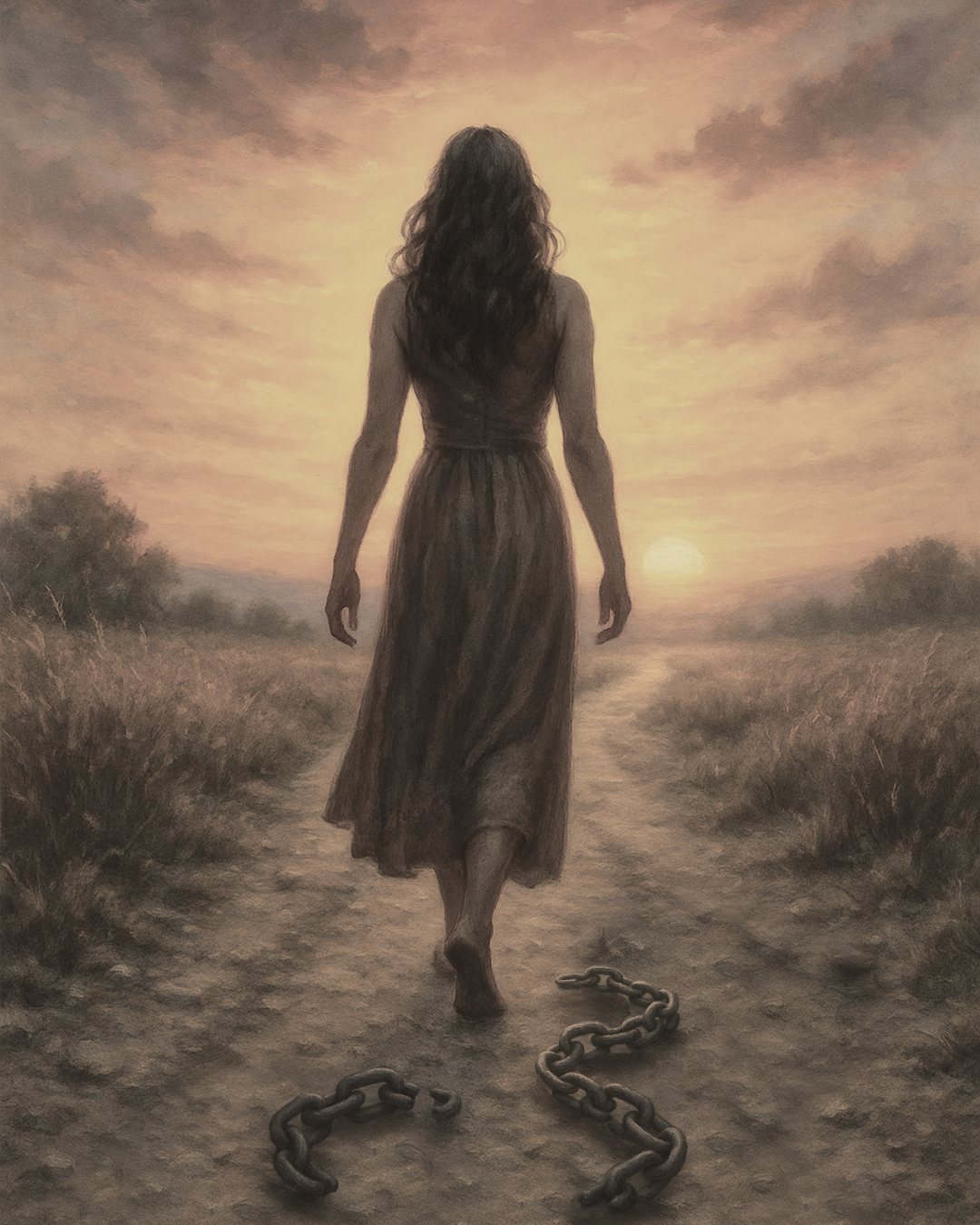
This Samhain, I have shed the chains that bound me. I have released the stories that kept me small. I have walked through the fire, and on the other side found something timeless — a serenity that hums beneath my ribs, constant as the tide.

Whatever shore I reach next, I know I will be all right. In this life, and the next.

I am free.
I am whole.
I am home.

And as the wheel turns, I feel the presence of God in my heart — the radiant pulse of creation itself. Above me, the moon watches in her quiet wisdom, her silver light guiding the way forward. Beneath my feet, the earth cradles me in her steady embrace. Together, they remind me that all things ebb and flow — birth, death, and renewal — and that I am part of this eternal rhythm. No longer chasing the light, I have become it.

The Road to Barrie - Reflections Between the Lines

October 13, 2025

This weekend, I drove up to Barrie to help my daughter and soon-to-be son-in-law host Thanksgiving dinner. It was my first long-distance drive since surgery — a milestone I wasn’t sure I was ready for, but one I needed to face. Driving a standard Jeep after a hip replacement isn’t exactly a recipe for comfort, but the moment I turned the key, I felt a quiet strength stir inside me. A sense of reclaiming something that once felt lost — the freedom to move, to explore, to show up for the people I love.

I never take the highway. It may shave time off the trip, but it also steals the view. The backroads are where the stories live — winding through small towns already dressed for Thanksgiving and Halloween, past cornfields brushed with amber light, and forests set ablaze in that fleeting autumn fire that only October brings. There’s something sacred about the slower route. When you choose it, it’s like the world opens up in gratitude, whispering, thank you for noticing me.

The Trans Canada Rail Trail runs parallel to those roads, and as I drove, I couldn’t help but think of my bike ride along it just less than five months ago — 600 kilometres on a busted hip, right before surgery. At the time, I didn’t fully grasp what that ride meant; everything around me was changing too fast. But as I followed the same route in my Jeep, healed and whole again, I finally had space to reflect.

I laughed. I cried. I karaokied my way up and back — a one-woman concert of gratitude, resilience, and release. With every kilometre, I thought about how far I’ve come, and that in the past year alone, I’ve accomplished things I never dreamed possible — the bike ride on a broken hip, a complete hip replacement, the completion of a 700-page novel, and perhaps most importantly, an entirely new perspective on living. I’ll be turning 50 soon, and instead of feeling the weight of it, I feel the lightness of becoming someone new — someone stronger, freer, more at peace with where I am.

That drive wasn’t just a trip to help prepare a Thanksgiving feast; it was a quiet pilgrimage. A reminder that gratitude isn’t just about what’s on the table, but what’s within us — the courage, the healing, the moments that bring us back to ourselves. Because when you stop trying to control every turn, when you trust the open road to guide you where you’re meant to go, you start to feel the universe moving with you — steady, patient, and full of grace.

Somewhere between the laughter and the tears, I sent a thought out into the world: I hope everyone, at least once in their life, feels this kind of alignment. That moment when the noise quiets, the light shifts, and you realise — you’ve made it through. You’re still here. You’re still singing. And the universe, in its own quiet way, is singing right back.

May this season remind us that gratitude is not reserved for perfect days,
but for the quiet ones — the ones that heal us in ways we don’t always see.
May your home be filled with warmth, your table with abundance,
and your heart with peace that lingers long after the candles fade.
May you find beauty in the detours, grace in the waiting,
and joy in simply being here — alive, present, and part of this ever-turning, beautiful world.

Happy Thanksgiving. 🍂

The Many Faces We Wear - October Reflections

October 06, 2025

At last, we’ve stepped into October, a month that always carries its own kind of magic. The air sharpens, leaves loosen their grip, and shadows stretch earlier across the day. It is a season of thresholds — of endings that prepare the way for beginnings. The harvest wanes, the light thins, and the veil between worlds — seen and unseen, self and shadow — grows whisper-thin.

And, of course, it is the season of the mask.

They hang in shop windows and drift across sidewalks, painted and feathered, waiting for one night of disguise. Yet long after Halloween passes, I find myself thinking of the masks we carry every day — not costumes, but the faces we slip into when the world demands them.

In the old ways, masks were more than playthings. They were tools of transformation — worn not to deceive, but to invite the sacred or the hidden to speak through us. Beneath the flicker of firelight, villagers once became spirits, animals, ancestors. The mask was a bridge between who we are and what we might become. Perhaps that is why October stirs something ancient in us — a longing to shed, to shift, to step for a moment beyond ourselves.

The artist’s mask was my choice. It was never forced upon me, but rather something I reached for willingly, almost instinctively. A way of seeing that I inherited from my father — not in hardship, but in wonder. This mask feels like second skin, a lens I use to shape colour into canvas and stories into pages. Over time, that same mask has carried me from painter to author. They are not separate personas, but layers of the same expression, growing and branching from the same root.

The work mask is different. It is steady, unglamorous, and deeply grounding. Cleaning houses isn’t an identity I boast of, but it is one I respect. In a world where artists can become lost in ego and illusion, cleaning humbles me. It reminds me that dignity lives in doing what must be done, that no task is beneath me. This mask does not take me away from creativity — it anchors me to the realness where art is born.

And then there is the mask I never chose: the healer’s mask. The one I was born holding. It has been my armour in the darkest nights, the mask I slip on when life becomes unbearable. It isn’t adorned or beautiful, but it is unyielding. It whispers survival. It carries the quiet promise that pain passes, storms break, and even shattered things can mend.

These masks — chosen, inherited, and born of necessity — have shaped me. They do not simply conceal; they protect, they reveal, and they teach.

Perhaps October reminds us that masks are not only for hiding — sometimes they are for becoming.
And so, this season, I walk forward as artist and author, worker and healer. Not divided, not disguised, but whole.

The Weight We Carry

September 26, 2025

Even when her voice is silent, I hear her in the colours left behind.

It has been ten years since my mom passed, and still the memory sits with me as if it were yesterday. People will tell you that time heals all wounds, but I’ve learned that time doesn’t heal—it reshapes. Grief doesn’t vanish. It stains the canvas of your life, layering itself into the background, always there beneath the new colours you add.

When someone you love leaves this world, it can feel like the ground gives way beneath you. At first, you might feel nothing at all. Numbness paints everything in muted tones, leaving you to wonder if something inside you has broken. And then, without warning, it arrives—the wave that flattens you. The flood of grief pours through every part of you, unrelenting, unstoppable. 

It leaves you empty and overflowing at the same time.

In those first months, I lived like a sketch without shading—present, but hollow. Still, my hands itched to create. Creativity has always been my way of breathing, and even in the numbness, I found myself reaching for brushes, for words, for colour. My grief found its way into every line, every stroke, every piece of work. Art gave me a way to move when my body felt paralysed, a way to shape the unshapable.

And in the months, years, even decades that follow, you learn that grief has no finish line. There is no final brushstroke, no moment when the painting is complete. It changes, it shifts, it finds new shapes—but it doesn’t go away. And so we keep layering it into the work of our lives. Sometimes it bleeds dark and heavy, other times it softens into light.

People mean well when they offer words—“It will get easier,” “Time will heal,” “They’re in a better place.” But if you’ve lived it, you know: words can’t reach that deep. That is why I turn to art. Creativity gives me a language for grief when spoken words fail. A canvas doesn’t tell me to move on. A blank page doesn’t flinch when I pour out what feels unbearable. Through art, the ache has somewhere to go, somewhere to live outside my body for a while.

Here is what I can tell you, from standing inside it: you are not broken. You are not weak for feeling hollow, detached, angry, or undone. Grief is not a failure to “move on”—it is the echo of love, carved into your very being. And if you create—whether through paint, poetry, clay, or song—let your art be the vessel that carries it.

Over time, you don’t “get over it.” What you do is learn to carry it. You learn to live alongside it, to build a life around the hole instead of trying to fill it. You adapt. You bend. And somehow, even in the darkest seasons, moments of beauty return.

One day, you notice a flower blooming that you hadn’t tended, or the way autumn leaves glow just before they fall. You realise that life is still painting itself forward, and you are part of that canvas. And in your own art—in every mark, every shape, every word—you find proof that even pain can create beauty, that even sorrow can be transformed into light.

Grief does not end. But neither does love. And in learning to hold them together—layered like brushstrokes, heavy and light—we discover a strange kind of strength. Not the strength of forgetting, but the strength of carrying, creating, and still blooming in the shadow of what we’ve lost. 


God and the Garden: Heart, Faith and the Creation of Soluna

September 16, 2025

Lately, a few friends have asked me about my personal practice—what it means, where it comes from, and how it fits with the fact that I still attend church and sing in the choir.
I understand why it might seem confusing from the outside. Christianity has been such a strong presence in many of our lives, and stepping outside its familiar boundaries can look like leaving something behind. But for me, my spiritual path isn’t about leaving at all—it’s about expanding.

Soluna isn’t a religion—it’s a path, a practice, and a living philosophy I created, woven from sun, moon, and earth. Together, these three offer a lasting support system: the sun, whose light is life itself; the moon, whose rhythm reminds us of our cycles; and the earth, whose grounding steadies us through every season of life. In a time when the world feels chaotic, and even the greatest religions sometimes seem to lose sight of their purpose, I turned inward and shaped this system as a way to reconnect with my spirit.

It grew out of a lifelong search that never seemed to find its landing. Like so many seekers, I spent years exploring various traditions—Wicca, Druidry, Eastern practices such as yoga and Hinduism, the Jewish mystical teachings of Kabbalah, Buddhist wisdom on mindfulness, and modern philosophies that emphasise energy and vibration. Each carried beauty, truth, and insight, yet none felt like home in its entirety. I was always caught between resonance and restlessness, longing for a path that honoured not just one part of me, but the whole.

It wasn’t until a long bike ride—miles of open sky, the steady rhythm of breath, the hum of wheels against the earth—that I understood: my path didn’t need to be chosen from a single mould. It could be woven. Soluna is that weaving. It is sun and moon, earth and spirit, the balance of joy and sorrow, creation and destruction. It is a way of living that honours universal laws while allowing me to gather what makes life vibrant and meaningful. For me, Soluna is not about rejecting other beliefs, but about embracing the harmony between them, and finding a way of walking through the world that feels deeply alive, deeply connected, and deeply true.

I still believe in God. I feel His presence in worship, in prayer, and in the joy of singing alongside others in praise. There is beauty in the choir loft, in the swell of voices rising together, in scripture that speaks of love, justice, and grace. Those things continue to anchor me. But my soul also longs for something broader, something that embraces the rhythms of nature and the cycles that have guided humanity since long before pews and hymnals. That is where Soluna comes in.

The name itself comes from the sun and the moon—symbols of balance, of the dance between light and shadow. Within this path, I honour (not worship) Elios, the solar creator who breathes life into all things; Selene, who guides the moon’s cycles and awakens our intuition; Gaia, the earth who grounds and nourishes; and The Morrigan, a force of justice, transformation, and necessary endings. She is not evil, but a reminder that creation and destruction are intertwined, and both belong in the balance of life.

For me, this is not a rejection of Christianity. It’s a way of walking with God through the earth He created—through the turning of seasons, through sunlight on my skin and moonlight on the water. Scripture reminds us there is “a time to plant and a time to uproot, a time to weep and a time to laugh, a time to mourn and a time to dance.” Soluna reflects that truth, not in opposition to my faith, but in harmony with it.

When I mark the solstices or equinoxes, when I light a candle to welcome the new moon, when I honour the crow as a messenger of justice and change, I am not turning away from God. I am finding Him in all the corners of creation. I am listening for His voice not only in church, but in the rustle of leaves, the howl of wind, the steady heartbeat of the earth beneath my feet.

I don’t expect others to embrace this as I do, and I know Soluna may feel unfamiliar—or even unsettling—for those who walk a strictly Christian path. But my hope is that you can see my heart in it. I am not walking away from God—I am discovering Him anew: in the sun He set to rise, in the moon He shaped to wax and wane, and in the earth beneath our feet that sustains all of life.

This is where my soul feels most at home.

September: A Season of New Beginnings

September 02, 2025

I remember when my kids were in school. God, does that feel like forever ago—lol. Yet those memories live in me like little time capsules. Back-to-school was never just a date on the calendar; it was a whole ritual that seemed to take over the end of summer—two weeks of preparation, anticipation, and excitement. There were shopping trips for new clothes that smelled of crisp fabric and fresh dye, the endless lists of supplies—binders, paper, pencil crayons—and the comforting aroma of sharpened wood and ink that came with them. It was chaotic, yes, but it was also sacred in its own way. It was the marking of something new, the feeling of standing on the edge of possibility.

It’s funny how the approaching Samhain season is considered a new year for those who walk the pagan path, and how closely it mirrors that same energy of back-to-school. Both carry the weight of endings and beginnings, the turning of a page. With Mabon drawing near—the time of balance, when light and darkness stand equal—I can’t help but see how September has always been a threshold. It asks us to pause and take stock, to gather the harvest of our days, and to recognise that change is not just coming, but already here.

Sometimes I find myself longing for those good old days, when my children were young and the air seemed to crackle with their excitement. I’d watch them pull on their brand-new sweaters, backpacks slung over shoulders too small for the weight of them, and I’d feel that bittersweet ache of time rushing forward. And while I’m thankful I no longer have to fill the endless hours of summer with distractions—lol again—there’s a quiet emptiness that comes with the passing of those seasons of motherhood. It lingers, especially in September.

But this year, I’m beginning to understand something I didn’t before. It isn’t just the back-to-school ritual that brings that feeling of newness. It’s the season itself. September carries its own kind of magic. The mornings grow cooler, mist rising over fields and streets like a soft veil. Pumpkins begin to appear on porches, the scent of spice winds its way through kitchens and cafés, and cosy knit sweaters find their way back onto our bodies like a second skin. There’s a hush in the evenings, a slower rhythm that invites us to breathe, to settle, to open a book and lose ourselves for a while. (Shameless plug: if you’re looking for one, my novel Through Bright Eyes is perfect for crisp September nights!).

What I realise now is that September has never been about the school buses or the stacks of notebooks. It’s about turning inward. It’s about remembering the child within us who once felt that flutter of anticipation, that joy in new beginnings, that hope in fresh starts. The wheel turns, the days grow shorter, and the earth begins its slow rest, wrapped in mist and silence. And in that stillness, we are invited to reflect—not only on how far we’ve come, but on the roads we still wish to travel.

September isn’t just another month. It’s a doorway. And when we step through it, we’re reminded that beginnings aren’t bound by age, or season, or circumstance. They live in us always, waiting for the courage to be embraced.

“The Sweetest Journeys Are the Ones We Never Saw Coming”

August 20, 2025

If you told me five years ago that I’d bike across Southern Ontario and publish a 700-page novel, I would have laughed you right off the map. One, because I never wanted to bike long distance—ever!  Two, because me? An author? Not in a million years.

The plan, from the beginning, was the Bruce Trail. Running it. — That was the dream I carried in my head: miles of rugged ground beneath me, the kind of punishing beauty that strips you down and rebuilds you. Running was freedom, and I thought it would always be mine. But then my hip gave out. The dream dissolved, and I was left staring at a new reality—one I did not want.

The Trans Canada Rail Trail. A bike. A choice.

At first, I hated it. The idea made my stomach knot tight — Every hill was an insult. Every gust of wind a fight I never signed up for. The seat, a cruel joke. I told myself it wasn’t running, it wasn’t the dream, it wasn’t me. And yet, I pedalled. One reluctant mile at a time. And then something strange happened. Somewhere in the grind, in the long silences, in the ache of my body learning a new rhythm, I began to soften. I began to see what was in front of me instead of what was lost. The mornings broke open into light I wouldn’t have seen otherwise. The small towns, the fields, the endless sky—they carried me. And without realising when it shifted, I fell madly in love with the ride.

I will run again. That part of me isn’t gone. But biking gave me something I didn’t know I needed: proof that the path we don’t choose can still carry us exactly where we’re meant to go.

Writing was another one of those paths. I never pictured myself as an author. Storyteller, sure—I’ve always had that in me. But books were for other people. In my mind, authors were the ones who devoured libraries, who read a thousand stories before daring to write their own. I wasn’t that. With my mild dyslexia, reading was always uphill unless the book had me completely in its grip. Writing my own? It didn’t even cross my mind.

But the stories inside me knocked louder with every passing day. They pressed and swirled and demanded to be told. So I tried. And then I kept trying. The words came clumsy, then faster, then unstoppable, until suddenly I wasn’t just writing—I was finishing. And not just finishing, but holding a novel in my hands. Me. The girl who never thought she belonged in that world. The girl who thought books were beyond her.

It’s humbling, really. The things I planned for—the ones I thought I couldn’t live without—were taken from me. And the things I never imagined—things I didn’t even want—were the ones that handed me keys to a life I never thought I could touch.

The path is never what we picture. Sometimes it breaks us. Sometimes it saves us. Sometimes it hands us the very things we were made for, but couldn’t see on our own. Sometimes the very thing we’ve convinced ourselves we can’t have is the only thing waiting for us when we finally let go.

I never planned to bike. But I found freedom in it.
I never planned to write. But I found myself in it.

Maybe the sweetest vision is the quiet miracle that waits for us after we’ve let go of the one we thought we needed—proof that the detours, the derailments, the unwanted paths are often the very ones that shape us into who we’re meant to be.

If running taught me freedom, biking taught me resilience. If writing showed me discipline, it also showed me belonging. I thought I knew what I wanted. I thought I knew the limits of what I could do. But life has a way of reminding us that the story isn’t finished just because we’ve lost a page.

The truth is: we don’t always get to choose the road. But we do get to choose to move. And in moving, in trusting, in saying yes to the paths we never planned for—we sometimes stumble into a life wider, deeper, and more breathtaking than anything we dared to dream.

So here I stand: a runner without a finish line, a cyclist who swore she’d never ride, an author who never thought she belonged on the shelf. And maybe that’s the point. Not to become the person we planned to be, but to become the person we discover in the unplanned.

And if that’s true, then the path ahead—whatever it brings—can only be possibility.

When Mountains Won't Move - “You’ve got to learn to live with what you can’t rise above.” – Bruce Springsteen, Tunnel of Love

August 14, 2025

That line can hit harder than you expect.

At first, you might take it as a challenge — one of those gritty, no-excuses truths. If you can’t change it, then suck it up and move on. But the more you sit with it, the more you realise — that’s not what it means. Not really.

Because some things in life aren’t about willpower. They’re not about working harder, digging deeper, or being stronger. Sometimes, no matter how much heart you pour into something, how many prayers, rituals, spells, or sleepless nights you give it… you still can’t rise above it.

Some mountains don’t move.
Some people don’t change.
Some wounds don’t fully heal.
And some truths remain, no matter how much you wish they wouldn’t.

That’s where acceptance comes in — not as surrender, not as weakness, but as a different kind of strength.

Letting go of the fight doesn’t mean giving up. It means choosing to live anyway. It means shifting from How do I fix this? to How do I carry this in a way that doesn’t break me.

We grow up on stories about conquering. Slaying the dragon. Climbing the mountain. Winning the battle. But what happens when the mountain isn’t something you can conquer? What happens when the dragon is chronic pain, heartbreak, or grief that lingers like winter frost that never fully melts?

I’ve spent most of my life running — maybe you know the feeling. Pretending you can fix things. Reaching the hard seasons and thinking you can somehow reshape them into something positive — and getting damn good at it.

I call it the fine art of turning shit piles into gold.

But here’s the truth: it’s exhausting.

Maybe you’ve done it too — pushing forward no matter how you feel and calling it “acceptance.” But it’s not. That’s denial. And for years, I was in it… deep.

Looking back, I see now that maybe it was what I needed at the time — survival magic. My own version of lighting a candle in the darkness just to keep walking. But all that buried grief and pain? It stacks up. It waits. And one day, the pressure builds until something erupts — like Beltane fire breaking through winter’s grip.

That was me this past December — on the edge, ready to blow.

But then something happened. Call it the grace of God, the love of Selene, the blessing of Morrigan, or the grounding of Gaia — something shifted. Maybe I’d had enough. Maybe I was tired of pretending to be strong. Maybe I didn’t give a flying f**k anymore.

Whatever it was, I stopped running forward and turned back. Back into time. Back through the spiral, like the turning of the Wheel of the Year. I began peeling away the layers I’d built to survive and looked at every “gold pile” with older, wiser eyes.

Have you ever done that — gone back, not to erase the pain, but to finally make peace with it?

Because here’s what I learned: burying your grief, loss, and hurt never makes them disappear. You carry them anyway — so you might as well learn to carry them with grace.

Acceptance is tricky. We think it means closing the door and never looking back. But real acceptance? It’s knowing it will walk beside you for the rest of your life — through every season.

It’s the Earth beneath your feet — steady and grounding, holding both your roots and your burdens.
It’s the Air that whispers perspective into the places you thought were silent.
It’s the Fire that transforms your pain into fuel, not ashes.
It’s the Water that teaches you to flow around the rocks you cannot move.

And like the Sabbats, it comes in cycles. Sometimes we’re in the Yule-dark, holding our pain close for warmth. Sometimes we’re in the Litha-light, able to see it from a place of strength. Both are part of the same wheel.

True acceptance is standing at the crossroads — your cloak of experience wrapped around you — and saying: Yep. I see you. I can’t change you — but I honour the part you’ve played in shaping me.

Because in the end, living with what you can’t rise above isn’t about defeat. It’s about walking beside it without letting it swallow you. It’s about weaving the pain into your story without letting it become the whole book.

Acceptance doesn’t make the mountain smaller, but it makes the climb gentler. And maybe that’s the quiet victory no one talks about — not conquering the impossible, but finding the courage to keep living fully, in harmony with the weight you carry.

A Blessing for the Unmovable Mountain

May the sun warm you when the shadows feel long.
May the moon remind you that even in darkness, light returns.
May the earth steady your steps and hold your weight without judgment.
May the wind carry away what you no longer need to bear.

And may you walk with courage — not because the road is easy,
but because you’ve learned you can travel it anyway.

She Who Walks Between Sun and Shadow – Reclaiming My Path at the First Harvest

July 31, 2025

Tomorrow marks Lughnasadh—the first harvest. A sacred moment between the bright fullness of summer and the slow spiral into shadow. This year, it falls under the waxing energy of the First Quarter Moon of August, a phase of momentum, decision-making, and brave commitment. How fitting.

Because this year, I am harvesting more than intentions. I am harvesting healing.

Two weeks ago, I underwent hip surgery—a physical surrender that marked both a painful ending and an empowering beginning. As I sit in the quiet of this eve, wrapped in soft light and the golden scent of late summer, I can feel the edge of something new. Something I've worked toward for years but only now feel ready to step into. Two weeks into healing—and for the first time in a long while—I feel whole.

Lughnasadh has always been a threshold for me. Not just a sabbat of grain and sun, but a personal New Year of sorts. A mirror I hold to the year I’ve lived so far. The choices I’ve made. The intentions I planted in the cold dark of winter and have tended with shaking hands and stubborn hope. Some have blossomed. Some have withered. Some, I realize now, were never mine to grow.

And still—I reap.

I reap the quiet knowing that pain has passed through me but not become me.
I reap the deep-rooted strength of survival.
I reap the clarity that comes when you stop watering dead things.
I reap love—from those who stood beside me in the storm.
And I reap myself—the version of me that waited patiently beneath the rubble for a soft, solid place to stand.

This is the first Lughnasadh in years where I don’t feel like I’m clinging to fragments.
The wounds of the past—abandonment, betrayal, the silent ache of being unseen—have finally been named and laid down. I no longer carry them like sacred stones. I don’t need them anymore.

Instead, I carry a valiant heart.
Not because I’m fearless, but because I’m ready.

Ready to face the darker months not with dread but devotion.
Ready to walk into the inward spiral of autumn with eyes wide open.
Ready to meet Samhain, not just as a celebration of the dead—but as a woman very much alive.

Lughnasadh is about sacrifice. About honouring what must be given up so something greater can grow. For me, that sacrifice has been the old narratives. The smaller self. The fear that I would never be enough, never be safe, never be fully me.

Tonight, I leave that on the altar.

And in its place, I leave space for the woman I’m becoming.
The healer. The witch. The artist. The seeker.
The fire-tender. The shadow-walker.
The one who no longer apologises for her light.

So tonight, under this first quarter moon, I whisper a quiet spell of gratitude.
For my body, in all its flawed, fierce glory.
For my path, even when it curved into thorns.
For this sacred breath, and this one, and this one.

May this Lughnasadh bless you too—with clarity, with courage, with the golden abundance that rises when we choose to keep going, even when the way is hard.

We are harvesters. And we are the harvest.

A Lughnasadh Blessing

May the sun's last golden blaze warm your spirit.
May your harvest be rich—not just in grain and gain,
but in wisdom, healing, and deep inner truth.

May you have the courage to lay down what no longer serves
and the strength to rise into who you are becoming.
May the sacred cycle guide you gently inward
as the year tilts toward shadow and dreaming.

May your heart be valiant,
your hands open,
your spirit rooted and rising.

And may you walk forward
not with fear of the dark—
But with reverence for all it will reveal.

Blessed Lughnasadh, beloveds.
May you reap with joy.
May you rest in grace.
May you rise in power.

<3

Bionic Hips & the Magic of Turning Shit Into Gold

July 16, 2025

Tomorrow’s the big day—my total hip replacement. I’ve been through surgeries before—seven of them, in fact. Four major. You’d think I’d be a seasoned pro by now. But nope. I’m sitting here this morning with a hot coffee in one hand and a lump in my throat, wondering why this one feels so different.

Maybe it’s because it’s not just about a hip.

I keep trying to tell myself I shouldn’t be this nervous. That it’s a standard procedure, that I’ll be up and walking again in no time. But nerves don’t care about statistics. They care about what you’ve lived through—and I’ve lived through enough to know that healing is never just physical.

Back in December of 2018, I was diagnosed with cervical cancer. One week after the biopsy came back positive, I was on an operating table for a total hysterectomy.

And everyone around me meant well. “It’s common.” “You’re done having kids.” “You won’t even notice it’s gone.”  

Right. I won’t notice it’s gone.

It’s just, you know, THE CENTRAL COMMAND CENTRE OF MY WOMANHOOD. No biggie.

My guy friends—bless their well-meaning male souls—tried to be supportive. But let’s be real—this isn’t something you can fully “get” unless you’ve lived it. When one of them said something along the lines of, “It’s okay, you’ll still be you,” I replied,  “Okay, picture this—you get your balls chopped off. Still feel like a man?”

 You could see the pause. The mental gears grinding. The slow, dawning horror. And then that little nod. “...Yeah. Fair.”

That surgery didn’t just take an organ—it stripped away something much deeper. For a year after, I felt like I didn’t know who I was. I’d look in the mirror and see a stranger. Someone who used to be vibrant, sensual, feminine—now just hollowed out and stitched together. I wasn’t mourning the loss of an organ. I was mourning the loss of me.

And it’s hard to explain that to people who haven’t been through it. Who think, because you look okay, you must be okay.

It took me a long time to come back from that. To start feeling connected to myself again. To feel like a woman again, on my own terms. And just when I finally started to find that version of me—strong, self-assured, grounded—my hip flared up.

And just like that, I went from “Am I still a woman?” to “Am I suddenly 90?”

Seriously. It was like I blew past midlife and landed straight in the shuffleboard league. One minute I was hiking and dancing, the next I was checking which chairs had armrests strong enough to push off from. And the icy porch fall? Just the universe’s way of putting a cherry on top.

For five years, this has been my quiet battle. A war of slow limitations. Little losses that add up. And somewhere along the way, I started believing that my active life—the one that made me feel free and capable—might be over.

Until something shifted.

Somewhere between the surgeon saying “We’re replacing your hip” and me deciding to bike across southern Ontario, something lit a fire under my ass. I don’t even know what happened—one minute I was limping, the next I was on a mission. It was like I got thrown back into my old self’s body. You know—the one I lost somewhere along the road of grief, surgeries, and relentless life curveballs.

I changed my diet. I hit the gym. I ran on a treadmill… okay, I hobbled. But I did it.
I pulled off my bike journey. And in the middle of all that madness, I finished writing a full novel—600+ pages of my soul spilled onto paper. I honestly don’t know how I managed to pull any of it off. It felt like I was living on borrowed time.

And now here I am. Sitting in the quiet, editing pages of that novel, sipping coffee, trying not to spiral about what’s coming next.

I don’t want to be negative. But I won’t lie—I’m tired.
Tired of always having to rise from the ashes. Tired of being the one who turns every disaster into a personal growth moment.
I’ve taken so many shit piles in this life and turned them into gold, it’s honestly starting to feel like a full-time job.  Tell me that’s not magic. Or maybe just trauma with a good attitude.

All I really want is for the universe to send me one thing that’s beautiful and easy and doesn’t come with a side of existential crisis.

If you’re reading this, I want you to know: I wasn’t born a fighter. I didn’t come into this world with armour and grit. I was shaped by life. Forged by every hard thing I never asked for.

And yeah—I’ll fight to come back from this too. I’ll do whatever it takes to return to the life I’ve rebuilt over and over again. But this time, I’m not going to pretend I’m fine just to make it easier for other people to watch.

I’m scared.
I’m exhausted.
But I’m still here.

Still showing up. Still swinging. Still hoping there’s light on the other side of this operating room.

Because even though this surgery is common, I’m not.
My fears are real. And they matter.

And if you’re in that place too—whatever your version of this is—I see you. I honour you.
Just don’t let yourself drift so far you wake up in the middle of the lake, wondering how the hell you got there.

Be honest. Be scared. And then—when you're ready—swim.

“Born of the Moon, Grown by the Forest” - Reflections on the Buck Full Moon

July 09, 2025

I think I’ve always been a pagan at heart—I just didn’t have the words for it until much later.

Being the youngest of eight, with a sixteen-year gap between me and my oldest sister, and six to the next in line, I grew up sort of sideways—on my own, figuring things out as I went. Flying solo. With no one around my age to follow, I made my own path. And of course, with a curious spirit like mine, that path always led straight into the wild.

I spent hours outside, deep in the woods behind our farmhouse, wandering without fear or hesitation. Back then, there was no such thing as danger or claustrophobia. Just open sky, whispering trees, and the steady hum of the forest breathing all around me. I belonged to it completely—nature’s wild child, barefoot and wide-eyed, collecting moss and stories in equal measure.

My dad was the biggest influence in shaping that bond with nature. He’d take me into the forest and teach me about the plants, calling them by name like old friends—what healed, what nourished, what to steer clear of. We'd harvest fiddleheads in the spring, nibble on spruce tips, gather wild garlic, wintergreen, stinging nettles, even dig chicory roots to toast for tea or coffee. Mushrooms were a whole other adventure—one we dove into with delight and caution.

It wasn’t a lesson—it was a legacy. The forest wasn’t just a place to play. It was sacred. Alive. And I learned to listen to it with reverence.

Before life got complicated, before the world cracked open and spilled the hard stuff in, my childhood felt like something lifted from a novel. And maybe that’s why my novel is so deeply rooted in those early memories—because they’re still the truest parts of me.

But no matter where I was or what I was learning, one thing always held me steady. The moon.

I was born under a waxing crescent, and my dad used to tell me that made sense— I was born under a storybook moon. We’d go for walks together, just the two of us, and no matter where we were in the province, he’d always point it out: Look up. There she is. And I’d smile, every time. I was fascinated. Enchanted. I couldn’t fall asleep without singing to her. Wherever I was, I’d find her, hum a little tune, and feel safe. Like she was watching over me.

That connection never faded. If anything, it’s only grown stronger.

Now I understand what it was—what it is. No question. This biking journey I just completed solidified that truth in my bones. I move in time with the Wheel of the Year. I honour the earth and the natural cycles. I speak to the moon like an old friend. I don’t claim Wicca or Druidism fully, though I respect and resonate with both. For me, paganism isn’t a religion. It’s simply… how I live. How I move through the world. And at the heart of it all, always, is the moon.

I’ve taken so many photos of her—full, new, hidden, bright. She’s followed me through every version of myself. Maiden, mother, crone. Joy, heartbreak, uncertainty, rebirth. Every phase I’ve gone through has been mirrored in her sky. Even when I couldn’t see her, I knew she was there. That quiet companion, watching from above.

This recent biking journey—every detour, every ache, every unexpected change in plan—transformed me. It reminded me of who I am at my core. And now, on the edge of yet another transformation, with my hip replacement just days away, I find myself standing still for a moment. Reflecting. Breathing. Listening.

Tomorrow is the Buck Full Moon.

This moon, named for the season when male deer begin to grow their antlers, is all about strength, renewal, and stepping into the next version of yourself. It’s not about leaving the past behind—it’s about building on it. And I feel that so deeply right now. I’m not discarding who I’ve been. I honour her. All of her. Every wound, every lesson, every mile pedaled and heartbreak faced has brought me here.

But now… I am growing.

Like the buck, I am rising into something stronger. I’m growing new antlers—spiritual ones. Intuitive ones. Sharper, more defined, more me than ever before.

And here’s what gives me chills: this Buck Moon is also the farthest full moon from the sun in all of 2025.

There’s something magical in that. Because lately, I’ve felt that distance too. Like I’ve been walking the outer rim of something divine, orbiting just far enough away to feel the cold. And now? I feel the shift. I am moving closer again. Closer to the warmth. Closer to truth. Closer to home.

I’m not afraid anymore to be who I’ve always been. The barefoot girl in the woods. The one who sings to the moon. The one who feels too much and speaks in symbols and weeps quietly when beauty brushes her soul. She’s not just a memory. She’s alive. And she’s guiding me forward.

So as the Buck Moon rises, I honour her. I honour myself. And I honour you, if you’ve felt that same stirring—that same need to remember who you really are.

Because maybe, just maybe…
You’re growing your antlers too.

Unfiltered: A Love Letter to the Girl That Didn't Fit

June 30, 2025

Dear Me,

I came across a photo today that I snapped during my big bike adventure. A pair of old train tracks, half-buried under wild grass, curving into a thick wall of forest. They were weathered and crooked and beautiful in their own way. Faded. Forgotten. Quietly rebellious. They didn’t demand attention—they simply existed. Curving away from the viewer, they left me wondering where they went… and why no one had bothered to cover them up.

I couldn’t stop looking at them.
Because in some strange, bittersweet way… they looked like you.

You’ve always felt like that.
Off the main path. Overgrown in places. Mysterious. Misunderstood.
Curving sharply away from what was expected.
Never quite where people thought you should be.
Never quite someone people knew what to do with.

And god, I wish I could go back and sit beside you in that lunchroom. Or outside that classroom. Or on your bed at night when the world felt too sharp and your skin didn’t quite fit right. I wish I could look you in the eye and say, “You’re not too much. You’re just… not meant to be less.”

You didn’t know it then, but you were carrying a kind of wild wisdom the world wasn’t ready for. And instead of being celebrated for it, you were punished. Picked on. Misused. Humiliated. You were forced to shed parts of yourself just to survive. And for what? For being a little too soft, a little too sensitive, a little too round and bright and different?

You were bullied because you refused to flatten.
And that’s not a flaw. That’s a flame.

But of course, you didn’t know that at the time.
You just knew how to protect yourself.
You did what so many brilliant, wounded little girls do: you disappeared into your imagination. You built secret worlds out of safety pins and storylines. You tucked your dreams into notebooks and hid entire galaxies inside your heart. You turned to food because it comforted you, and to art because it made sense when nothing else did. You lived on the edges of things, because being in the center meant exposure—and exposure meant pain.

You thought that if you could just become the version of yourself they wanted—quieter, smaller, sweeter—you’d be safe. You thought that if you could become someone’s cup of tea, they’d stop trying to spill you.

But you were never anyone’s cup of tea.
Actually, maybe you weren’t even tea at all.
Because you, my love, are moonshine in a coffee mug.

Messy. Strong. Unexpected.
You don’t sip a soul like yours—you survive it...
Being around you makes people feel something. Sometimes too much. Sometimes exactly what they needed. You’ve got that strange magic that makes people confront parts of themselves they’ve tried to hide. And that’s not easy to be around—but god, it’s unforgettable.

That’s what they didn’t understand.
That’s what scared them.
That’s why you were mocked and torn apart and told to tone it down.

Because you weren’t made to fit in. You were made to wake things up.

And yeah, that made you a walking target.
But it also made you who you are.

You grew into someone who sees beauty where others see broken — not the delicate kind of beauty people frame for comfort, but the kind that makes them uncomfortable. You see it in the wreckage. In the unraveling. In the people who are barely holding it together. You notice what others look away from: the chaos behind someone’s anger, the panic beneath their arrogance, the exhaustion in a perfectly timed smile. You’ve learned to spot the flicker in someone’s eyes when they’re begging not to be seen — and you see them anyway. You cry at sunsets because they remind you what it feels like to stay soft, and you laugh mid-breakdown because you’ve earned the right to find light in places it was never supposed to exist. You carry darkness like a story and light like a match, and you don’t need to choose between the two. You’ve made room for both — not because it’s easy, but because you had to. And that? That’s your fire.

You’ve got grit in your soul and glitter in your bones.
You’re soft in all the right places, and stubborn in all the others.
And after hundred of km’s on a busted hip, you finally started to see that strength doesn’t always roar. Sometimes it just… keeps going.

So no, you’re not that little girl anymore.
But she’s still in there. Still coloring outside the lines. Still asking “what if?” Still flinching when people raise their voices or raise their eyebrows. But she’s safe now. Because I’ve got her. I’ve got you.

We don’t need to hide anymore.
We don’t need to edit.
We don’t need to fit.

We get to be too much.
We get to take up space.
We get to curve wildly into the forest and let people wonder where the hell we’re going.

We are unfiltered. Unapologetic. And finally, free.

Not tea. Not tame. But a spirit that leaves a burn — and a memory.

With everything I’ve got,
Me xo

To the Edge - A Reflection on Choosing to Live, Wildly and Truly

June 24, 2025

There is something profoundly sacred about reaching the very edge of yourself. Not merely your physical limit, but that razor-thin, fragile place balanced delicately between breakdown and breakthrough. It is the quiet, terrifying moment where your breath catches sharply, your bones ache deeply, and something deep within your soul whispers gently yet insistently, "Keep going anyway."

That edge—the very same one that most people spend their entire lives carefully avoiding—that’s precisely where life begins to feel truly real again. It's the place where all the masks and pretences finally fall away. It's where you reconnect with the person you were deep down before the world insisted on telling you who you should be.

Life gets hard.
Unrelenting.

It piles up—grief, expectations, bills, pain, small talk, pressure to perform, and endless responsibilities. Slowly, these burdens accumulate until we can no longer resist them and instead begin absorbing their weight. We convince ourselves that feeling exhausted all the time is simply a natural part of adulthood. That not recognizing the person staring back at us in the mirror is just a sign of “getting older.” That it’s perfectly normal to feel uneasy, disconnected, and dim inside, as if this is just how life is meant to be.

But what if none of that is normal?
What if it’s just common?
And what if… “normal”… isn’t the goal at all?

I’ve always lived as if tomorrow wasn’t guaranteed—because the reality is, it simply isn’t. I don’t say this to sound poetic or tragic, but purely because it’s an undeniable truth. And when you truly come to know this—when you allow that truth to settle deep within your bones—you naturally stop wasting precious time pretending that life is merely a rehearsal or a practice run.

We are not meant to sleepwalk through our years without truly experiencing them. We are not meant to fill our days with things that fail to inspire or light us up from within. And yet, somehow, despite this understanding, we often do just that. We numb ourselves to the vibrant emotions and sensations around us. We quiet the powerful instincts that guide us. We trade our natural passion and vitality for the dull comfort of predictability. We come to believe that “growing up” means silencing everything childlike, wild, and free within us, forgetting that those qualities are essential to a fulfilling life.

As children, we were pure instinct.
Joy was our default setting.
Wonder wasn’t something we had to chase—it was already there.
We didn’t need permission to dance barefoot, scream into the wind, or cry when we needed to.
We didn’t apologize for taking up space.
We didn’t shrink… and then one day, we did.

For the past five years, I almost let life completely flatten me. I got dangerously close to giving in to the version of myself that moved quietly and passively through the world, merely checking boxes, playing roles, and pretending that fulfillment could wait and come later. I nearly forgot what it truly felt like to live as if I meant it—with intention and passion. To feel the vibrant pulse of my heartbeat in my fingertips. To chase something with no other reason than simply because I wanted to. To finally reclaim my own story and take ownership of my journey.

And then came this bike ride.
This wild, unexplainable, soul-ripping journey.

I didn’t know, when I started pedaling, that I was also pedaling back toward myself in a deeper, more meaningful way. Toward the version of me that refuses to be numb in the face of life’s challenges. Toward the woman who still cries quietly at sunsets and finds a trace of God in the gentle movement of the wind. The one who doesn’t feel the need to explain herself in order to be seen as worthy. The one who is both fragile and ferocious—and has finally come to recognize that this duality is a true source of power, not a flaw to be hidden.

From the outside, people might only see chaos. They might view someone who is unpredictable, deeply passionate, and difficult to pin down or define. And maybe, in some ways, they’re right. However, I’ve come to stop seeing that as something broken or in need of fixing. Because while a predictable life might feel safe and secure—safe doesn’t ignite the fire within your soul or bring true fulfillment.

Growth doesn’t happen within the limits of comfort zones. True peace doesn’t arise from pretending that everything is perfectly fine. Genuine joy isn’t found through flawless perfection. Instead, it comes from the courageous choice to show up fully in a messy, uncertain, and beautifully complex world, and to honestly say, "This is me. Still breathing. Still trying. Still here."

If something in your life is broken or no longer serves a positive purpose— fix it. If it no longer feels like it belongs to you, or no longer resonates with who you are— leave it behind. If it dims your light or drains your energy—walk away, even if your voice shakes and your heart races with uncertainty.

We only get one shot at this.
One lifetime in this body, on this Earth, in this chapter.
I refuse to spend mine being anyone other than who I truly am.

And yes, that version of me might scare people.
She might not make sense to the world.
She might change her mind, cry too much, laugh too loud, run wild.
But she is awake.
She is alive.

And maybe—just maybe—that’s exactly what we’re here for. To remember who we truly are. To rediscover the joy and wonder in life, to fall in love with it all over again. To reach the edge of what we think is possible…and then find the strength to keep going beyond it.

If you feel like you’re at your absolute breaking point—don’t turn away or run from it. Instead, lean in and face it head-on. That edge you’re standing on right now might just be the very beginning of something new and transformative.

Not of your undoing—
But of your becoming.

The Light at the End of the Trail - A Litha Reflection

June 19, 2025

There is something about timing that gives me chills. Not the spooky kind - but the deep, soul-level kind. The kind that makes you pause mid-step, mid-breath, and go…whoa.

This past Sunday, I snapped a photo on my ride. The trail stretched straight ahead, flanked by towering trees. Sunbeams spilled through the branches, slicing the shadows, lighting up the path like something out of a dream. I didn’t realize it at the time, but that image has been sitting with me all week like a little breadcrumb from the universe.

Because this Saturday, I ride the final 50–70 km of a journey that has, in every possible way, changed me. And somehow—uncannily, perfectly—it all wraps up on the cusp of Litha.

The Summer Solstice. The longest day of the year. A sacred moment when light and life reach their peak, when we honor the sun’s strength before the slow return of shadow. In the Wheel of the Year, it’s a time of celebration, of full bloom, of fierce beauty—and of balance. Light and dark. Fire and stillness. Growth and gratitude.

And it hits me now: this wasn’t just a bike journey. It was a ritual. A soul trek. A balancing of my own inner fire and shadow. I’ve faced fears I didn’t know I had. I’ve powered through sand and silence, forests and fog, pushing my limits with each new pedal stroke. And somehow, through grit and grace and sheer will, I made it here—to the threshold of Litha.

It's almost too poetic, but also exactly right.

I’ve worked hard. I’ve earned this. Not just the mileage, but the inner shift. The quiet power of saying I did that. I kept going, even when I wanted to stop. I showed up for myself. Over and over again.

So here I am. On the brink of the Solstice. Lit up from the inside out.

And if you’re reading this—this part is for you.

May you find the courage to face your demons.
To ride straight into the wilderness of your fears.
To chase something so bold, so wild, and so true
that it changes your life forever.

Blessed Litha, friends. Let the light find you—and may you never be afraid to follow it <3

"The Forest, the Fear, and the Freedom to Choose"

June 17, 2025

Have you ever felt alone?

I don’t mean alone like “no one’s answering your texts” or “you’re third-wheeling at dinner.”
I mean really alone.

The kind of alone that creeps in even when you're surrounded by people. When you're at a party, or in a room full of noise and laughter, and somehow you still feel like you’re floating outside of it all. A ghost brushing past the living.

You look around at a world full of millions—billions—of people, and still feel like no one sees you. Like no one really hears what you’re trying to say. You try to explain how you feel, and the words come out hollow. People smile, nod, move on. And you’re left wondering if maybe you’re just too much. Or not enough. Or maybe just different.

And so you pull back. You shrink yourself. You go through the motions. You smile when you’re supposed to, laugh when it’s expected. And slowly, you stop showing up as yourself.
You go numb just to get by.

That kind of disconnection—I felt it full force this weekend.
But not in a crowd.
In a forest. Alone.

I was about an hour or so into Saturday's ride—third weekend in a row. My body was already feeling the pinch from the past two weekends.  My hip flaring. A constant reminder it needs to be replaced. And then came this stretch of trail just outside Barrie that almost cracked me wide open.

The first path on this journey that looked ominous and disappeared into a thick forest. Not the cozy kind—the ancient, haunting, towering kind. The trees were massive and closed in tight around me, blocking nearly all the light. Just these tiny, cold slivers of sun slipping through the canopy, like little knives cutting through shadow. If it had been overcast? I swear it would’ve been pitch black in there.

And the trail itself? A wreck. It looked like a river had torn through it. Deep ruts, gnarled roots, torn earth. The kind of terrain that makes you swear out loud. Hills that didn’t end. No breaks. No breathers. I had to get off and walk most of it, dragging my bike along behind me, my hip screaming.

I was alone in that forest for almost an hour. Not another soul.
No sounds but the creak of trees and the crunch of my steps.

And just when I thought maybe—maybe—I was almost out, I came to this junction. Three paths. No signs. No idea where any of them led. Just trees, and dirt, and silence.

I looked at my phone—thinking I’d just check my GPS. But nope.
No signal.

My stomach dropped.

In a split second, the forest didn’t feel quiet anymore—it felt suffocating. The air thickened. The trees pressed in. I felt the weight of every single direction, and the fear that if I chose wrong, I’d just disappear deeper into nowhere.

I stood there frozen.
Brain racing. Heart pounding. A hundred nightmare scenarios playing out in my head. And not one of them ending well.

But here’s the thing—and it’s the part I hope someone out there really needs to hear:

You don’t need to be lost in a forest to feel that way.

Sometimes in life, we do everything “right.”
We show up. Work hard. Smile. Say the things people want to hear.
We push through the motions like machines.

And still—we feel empty. Disconnected. Drifting.

And I don’t think that’s failure.
I think it’s a sign.
A wake-up call from the universe.
Something has to shift.

Because you can’t keep living the same script and expecting your soul to thrive.

Just like those three trails in front of me—we often find ourselves standing in life, staring at options. Not sure where they lead. Terrified of picking the wrong one. But standing still? Not choosing? That’s not safe. That’s how you stay stuck.

And here’s the thing: the sun doesn’t wait.

You wait too long, and the light starts to fade. The trail disappears. And with it? So does the opportunity.

So I did the only thing I could:
I chose.

I took one of the paths—no signs, no GPS, no guarantees. Just my gut and a shaky breath. Eventually, I made it. The trees thinned. The sun hit my face again. And I was out.

Here’s the kicker though: all three paths led out.
Each one would’ve gotten me there.
The only difference was how long it took.

So it’s not about choosing the perfect path.
It’s about having the guts to choose.

So let me say this, loud and clear:
If you’re standing at a fork in your life right now, stuck in fear, waiting for some kind of magic green light to show up and give you permission?

Stop.

There’s no perfect timing. No flawless plan. No guarantee.
There’s only you—and your ability to move forward anyway.

Standing still is a choice too.
And it’s the one most likely to cost you everything.

So choose. Pick a direction. Let it be messy. Let it be bold. Let it scare the hell out of you.

Because freedom?
It’s not found in avoiding the unknown.
It’s found in walking straight through it.

This life is not a rehearsal.
This is it.

So don’t you dare stand at the fork and stay frozen.
Choose.
Own it.
Ride it like it’s yours.

And never look back.

Morning Sunbeams Caught in Yellow Petals

Where the Trail Meets My Soul

June 10, 2025

Somewhere between the rhythmic click of my gears and the gentle whisper of the wind, I discovered the soothing, quiet hum of my own heartbeat once again, a reassuring reminder of my existence in this vast and enchanting world.

This biking journey—this strange, stubborn commitment I made after sitting in an uncomfortably sterile room, nodding my head in agreement as a surgeon calmly said, “You’re getting a new hip”—has evolved into so much more than merely counting kilometers and achieving physical fitness. It’s gradually transformed into the essential thread that is now stitching back together the jagged pieces of a heart that had been long cracked by the passage of time, profound emotional loss, deep-rooted betrayal, and by fears that I rarely dare to speak aloud or even acknowledge in the quiet moments of reflection.

At 4am, when the world is still and silent, and even the birds are peacefully sleeping, I slowly rise from my bed. Groggy, aching, and feeling uncertain, yet, somehow I still manage to push myself to rise. Because somewhere out there is a field glowing gold with wildflowers I haven't seen yet. Somewhere out there is a forgotten memory waiting to be remembered—and released.

I ride with ghosts.

Sometimes, it’s the gentle scent of lilacs that brings unexpected tears to my eyes. Or perhaps it's the warmth of a sunbeam softly warming my face, just like it use to when I soared barefoot on the old rope swing hanging from the giant maple tree out front my childhood farmhouse. I pedal through landscapes that seem to speak to me, softly urging, “It’s okay to let go now.” And I do. I let go. I give those heavy memories to the wind and watch them scatter like dandelion seeds.

Turning 50 once felt like a death sentence. The looming hip replacement, a closing door.

But now, after 370 km of hard-fought, soul-sweating trail, I know the truth: it’s not the end: It’s a beginning. A hard-earned one.

In my 20s, I never could have imagined this strength. Not just in muscle or mileage—but in heart. In presence. In forgiveness of myself and others.

And as the wheel of the year keeps turning, and blankets of snow fold gently over the trails I’ve ridden, I’ll find myself standing in the serene hush of my birth eve, and in that moment, I’ll know which direction my soul truly longs to go. I’ll feel it deep in my bones, like the sun on my cheeks, or the wind through my hair.

This journey isn't just about moving forward.
It’s about coming home.

If you’re out there right now—wondering, aching, seeking—go out into nature. Pour your heart into the trees, the wind, the wildflowers. Tell the river your fears and whisper your hopes to the sky.

And then be still.

If you choose to listen—truly listen—nature will answer.
She always does. <3

Walking My Own Path - "A Pagan Life Lived Quietly, Deeply"

June 03, 2025

The world often expects clarity in labels—neat definitions, clean categories, shared rituals. But my path through Paganism has never walked the well-trodden road. It moves like water, shifting and flowing to meet me wherever I am in the moment. It is not bound by tradition for tradition's sake, nor is it always easily explained. It simply is—woven into the tapestry of my everyday life, steady and unseen, like the roots beneath a wild forest.

I’ve always felt the pulse of the earth in quiet moments—watching the wind stir the trees, hearing the call of a distant bird, feeling the hush of dusk settle over a long day. These, for me, are sacred. While others may mark the wheel of the year with grand ritual or communal gatherings, I find my connection in subtler ways: in lighting a candle with intention, whispering gratitude into the soil, crafting small altars of natural things that speak to a feeling I can’t quite name.

I don’t always follow the rituals in a formal sense. I don't wear robes or chant invocations under the moon—though sometimes I do, if it feels right. My practice is deeply intuitive, shaped less by books or traditions and more by moments of resonance. I honour the seasons, yes—but sometimes that honouring is a silent walk through fallen leaves, or a moment of reflection with my hands in bread dough, thinking about the grains and where they came from. Sometimes it’s as simple as pausing long enough to feel connected.

Lately, I’ve taken that connection one step further—onto the open road, with nothing but two wheels, my breath, and the rhythm of my own heartbeat. My biking journey has become a sacred act in itself. Not just a physical challenge, but a spiritual return. With each push of the pedals, I move through landscapes that stir something ancient inside me. Trees blur past like blessings, the scent of wildflowers carries messages, and I feel myself slowly returning to the person I was always meant to be.

This journey isn’t about escape—it’s about remembrance. About deepening my love for the natural world and reclaiming the parts of myself that have been buried beneath the noise. The road teaches me patience, humility, awe. It teaches me how to listen again—to the wind, the earth, my own spirit. And through it all, I feel God's presence beside me in a profound and comforting way. Not in some far-off temple or elaborate house of prayer, but rather in the gentle sunlight warming my arms and the quiet miles of journey unfolding gracefully ahead of me.

This path, my path, doesn’t always fit neatly into the definitions people expect when they hear “Pagan,” Mine is a quieter devotion—less about the outer trappings and more about the lived experience. It’s the way I move through the world. The reverence I carry in the mundane. The presence I try to bring to each interaction—with people, with animals, with the land.

And isn’t that one of the gifts of Paganism? That it is not simply a single doctrine or belief system but rather a vast and expansive sky filled with a multitude of possibilities and diverse ways of living. A living, breathing relationship between self and spirit, shaped by culture, ancestry, instinct, and choice. Some paths are clearly marked. Others, like mine, are traced slowly with the soles of bare feet.

There are days I question if I’m “doing it right.” I think many of us do. Especially when so many voices in the spiritual community have strong opinions on what devotion should look like. But over time, I’ve come to understand that what truly matters most is not necessarily how others perceive me and my practice—it’s fundamentally about how deeply I feel and connect with it on a personal level.

I may not always speak of it. I may not always write spells or draw circles or call in the elements aloud. But I live it. In every mindful breath, in the way I speak to trees, in the trust I have in the cycles—both within and without.

So if you too find yourself walking a path that doesn't look like anyone else's, I offer you this: keep walking. Or riding. Or stumbling forward one step at a time. Trust that your connection is valid, even if it doesn’t follow tradition. The Divine meets us where we are—not just in ceremony, but in dishwater and dirt, in laughter and grief, in solitary moments when no one else is watching.

Paganism is not a performance. It’s a becoming.

And this—this life I lead, this deeply personal, ever-evolving rhythm—is my sacred rite.

"Free Spirit" - What it is and isn't

August 31, 2024

I thought today would be a good day to sit quietly and contemplate the term “free spirit.”

I've encountered this term many times in my life, and it has always been directed at me in different contexts, each time carrying its own unique weight and implications. Honestly, these have never been particularly positive, leading me to reflect on the impact and ways in which it has influenced my experiences and perceptions over the years. When I hear the term “free spirit” (and yes, I will be quoting this term throughout this post), My brain creates a series of thoughts and associations and I often drift to words like lazy, flaky, noncommittal, unreasonable, self-indulgent, disrespectful, stubborn, and standoffish, and in some cases I infer a hint of narcissism. So in actuality this phrase evokes a complex mix of characteristics that I almost always perceive as negative. Over my 48 years on this marvellous planet, I have grown to develop a strong aversion to it, which I now realize should be embraced rather than rejected. In reality, this post serves a dual purpose; it is a space for reflection and, more importantly, a tool to convince myself that being a “free spirited” individual is, in fact, a truly positive thing that brings richness to life.

So where do I start on this topic? Well, let’s begin with the word “term.” What exactly is a “term”, anyway? In the case of this post, the definition of term is as follows. - It refers to a word or phrase used specifically to describe a particular thing or to effectively express a concept, especially within the context of a certain kind of language, branch of study, or area of behaviour. - Phew, that lengthy description left me feeling as though I had marbles clattering around in my mouth!

Ok, so now that we have a clearer understanding of what a “term” is in this context, let’s explore the question: why do we actually need them? I suppose we might as well ask why we need anything at all in this intricate web of life... lol. - To answer this question, I would say as follows: (for those of you who may not know, I’m actually a high school drop out, so I am, in a sense, mostly talking out of my ass at the moment. However, if I’m being completely honest, my perspective is genuinely rooted in a place of personal wisdom and instinctual gut feelings. Hahaha! "Free Spirit" 101 right there!) Ok I should get back on track. We need terms to help us better understand. Plain and simple, right? Well…maybe, and maybe not.

We live in a day and age where specific terms can actually be harmful depending on the context in which they are used. To be honest, our language—both body and verbal—has become so inconsistent that we often find ourselves walking away from conversations, and wondering what exactly that person meant by their words. I believe this is largely because we are now functioning as an interconnected international globe, representing the entirety of our diverse world as a whole. And as such it can lead to misunderstandings that linger long after the exchange has ended. All parties of the conversation will ultimately make conclusions based on their own opinions and beliefs about themselves, which are most often shaped and influenced by their upbringing and life experiences. Ah ha! And there you have it, clear as day. Those last seven words which hold significant meaning. “Influenced by their upbringing and life experiences.” So in actual fact, it really has much less to do with the “term” itself and more to do with the individual who chooses to define those terms within themselves. Oh how I could go on and on…lol.

Now this is where it gets a bit sticky. I will add a disclaimer that everything written moving forward is solely the beliefs and opinions of myself and do not reflect the views or sentiments of the whole. If you resonate with my opinion, that is absolutely fantastic and greatly appreciated. If not, that is perfectly fine too, as we all have our own unique ideas and opinions about various things in life. If you find yourself feeling angry by my words and believe they strike a chord within you, I challenge you to take a moment to look deeper. Sometimes the things that trigger anger can be truths that are desperately begging to be brought forth.

So, here we go. I am, without a doubt, an artist. I was born an artist. I am the byproduct of two extremely creative individuals, so my mold is undoubtedly solid! Interestingly, I have only truly embraced some of my authentic self within the last five years. Yep, that’s right. I will be turning 49 in just three months, and only now am I genuinely acknowledging my self-worth. That’s pretty pathetic, isn’t it?

Throughout history the term “free spirit” has been largely associated with creative individuals. My father is a fine artist, a creative spirit who has made a name for himself in certain circles. Some of you may know who he is, while most might not have heard of him at all. I care not to share too many personal details about our relationship, as that feels quite private. However, the only aspect relevant to this post is that he severely missed the mark when it came to fatherhood—of any kind of relationship, really. His absence and lack of engagement throughout the years created a ripple effect of negative experiences that permeated throughout my childhood, impacting relationships and shaping perceptions of my self-worth. Growing up, I had to endure endless, degrading comments about him that were repeated over and over again, echoing in my mind like a relentless drumbeat. Ok, so I get it. Yes, he was indeed a selfish man, who consistently lied and weaselled his way through life with no regard for the feelings of others. He dropped his responsibilities like they were hot coals, showing a complete lack of concern as he moved through life without a care in the world for anyone other than himself. Yes, he is truly the epitome of narcissism, even though I deeply dislike engaging in name-calling. And yes, as I have also heard over and over again throughout my life from various family members and friends, I am indeed a carbon copy of him, sharing not only his physical traits but also many of his mannerisms and eccentricities. Which naturally leads me to wonder, what does that make me? Ohhhhh the many years of my life I have spent running away from the arts! Give me anything, ANYTHING… just don’t give me a paint brush!

Unfortunately, this perpetual avoidance had me ping ponging through life, bouncing from one moment to the next in a seemingly chaotic manner. From the outside looking in, it almost appeared as though I possessed the same uncaring personality as my father. Internally, however, it is a completely different story altogether, filled with complexities and emotions that often went unnoticed by those around me. There would be fleeting moments throughout my life where I would occasionally dabble in what came naturally to me, only to swiftly snuff it out with self-doubt. The overwhelming urge to not become an artist constantly insisted and grew stronger with each and every lapse I experienced, leaving me questioning my choices and the validity of my dreams.

There is no doubt about it; running from what comes naturally has derailed my life in countless ways that I never anticipated. It has sent me down roads I didn’t truly need to follow, paths that have led to confusion and uncertainty. This avoidance has created turmoil and deep grief within my very soul. Like any great creator, the churning of the need to mold, move, and create something beautiful from nothing only grows stronger and stronger and the more I resist the call to embrace it the worse it gets. Don’t get me wrong, I don’t write these words with any sense of regret lingering on my tongue. We cannot control every single aspect of our lives, particularly when we are still children. The important note I’m trying to convey here is that I was running away from certain characteristics that I mistakenly believed to be evil. I constructed a perception based on the opinions of others, along with the negative traits I was aware my father possessed, and I assumed that if I were to fully embrace my true being, I would end up being no better than a flawed human on this planet.

Where does that leave us in relation to a more comprehensive definition of what it truly means to be a “free spirit”? Or perhaps it would be more enlightening for me to start by clarifying what a “free spirit” isn’t. It is, without a doubt, NOT selfish, all-consuming, vindictive, or narcissistic! These negative characteristics are often the unfortunate byproducts of a childhood riddled with trauma, fear, and instability. It is essential to recognize that ANYONE can carry these harmful aspects within themselves. In contrast, “free-spirited” individuals will more often than not generously hand you the shirt off their back without a second thought. They experience emotions on a level that can often feel incomprehensible to others. Their profound connection to the whole enables them to visualize, dream, and sense things on a very deep and meaningful level. They often seem as though they have no structure or predefined limits, but in fact, they only come across that way because, in their mind, there are simply no restrictions or boundaries to confine them. This life is only lived once, and to someone who identifies as “free spirited,” they embrace and experience it to the absolute fullest, pursuing their passions with enthusiasm and without regrets. They challenge themselves with great gusto, and if someone happens to be caught in the crossfire of their adventures, it certainly isn’t done purposefully or with malice. A “free spirit” genuinely doesn’t intend to hurt others; their focus is on celebrating life and exploring the possibilities it offers. A “free spirit” may come across as selfish, but in actuality, they are just highly independent individuals who value their autonomy. They prefer to stand confidently on their own two feet, and most often than not, they do not like to rely on others for their personal journey through life. Sometimes, their deep-seated need to be by themselves is so great that it can appear as though they don’t care for others. However, that is not the case at all, as a “free-spirited” individual cares deeply about those around them. In fact, their intense emotions and strong feelings can sometimes become overwhelmingly profound, leading them to retreat into a state of solitude for reflection and peace. As I take a moment to write this down, it all makes complete sense regarding why most “free spirited” individuals are often inherently creative individuals. Their open-mindedness and willingness to embrace new experiences and ideas allow them to explore different perspectives, which in turn fuels their imagination and artistic expression. In order to successfully create something meaningful from nothing and then represent it to others in a way that allows them to feel and connect with that creation, they must not be restricted or limited by the perceptions and ideals of the larger society or the whole. They’re in actual fact unique individuals who possess the remarkable ability to connect with the intangible realms of inspiration and emotion, transforming these ephemeral ideas into a tangible works of art that resonates deeply with others.

So, in conclusion, this rare breed of individuals should truly be celebrated and applauded for their unique contributions to society. For without such visionary thinkers and creators, the world, in its entirety, would undoubtedly seem drab, monochromatic, and disconcerted. The unconventional, “free-spirited” persons of history, such as DaVinci, Mozart, Abbas Ibn Firnas, Freud, Amelia Earhart, Picasso, Charles Darwin, and Albert Einstein, to name just a few, broke the prevailing rules of their time and changed the trajectory of the world in leaps and bounds. I could go on and on, highlighting countless others who have transformed human thought and expression. Therefore, I feel deeply honoured to find myself among a small pool of unique individuals who strive to make an impact on the world, whether big or small. It is my aspiration to leave a part of myself behind in all the works I produce moving forward, as well as in the lives of the people I have touched during my brief time on this plane of existence .It is truly an immense honour to be “free”, to break the chains of societal norms, to soar high above the limitations imposed by others, and to embrace and celebrate all that life has to offer in its rich, vibrant complexity. If you too have been referred to as a “free spirit,” know that you are among many individuals who are greatly needed in this ever-evolving world. Shine bright and unapologetically! Be the beacon of light that those who find themselves lost in the dark can look to and follow. Chase your dreams relentlessly and always rely on your gut instincts. Break the “norms” that seek to confine you and never allow your passions to be squashed. You, my friend, are a true game changer, and there is absolutely nothing wrong with that!

Prev / Next

Walking a Pagan Path

“In the mystical land of spirituality, every soul dances to it’s own unique melody.

When it comes to creativity, there are no rules; just a colourful mashup of everyones’s individual eccentric viewpoints

No roadmap exists for this unpredictable journey we call life - it’s a wild and whimsical adventure from beginning to end!” ~ TMA


Featured Posts

Featured
Dec 12, 2025
Kindling the Heart: A Yule and Christmas Meditation
Dec 12, 2025
Dec 12, 2025
Nov 29, 2025
Seven Days to Fifty - A Life in Storyform
Nov 29, 2025
Nov 29, 2025
Nov 1, 2025
Samhain Reflections - Coming Home to Myself
Nov 1, 2025
Nov 1, 2025
Oct 13, 2025
The Road to Barrie - Reflections Between the Lines
Oct 13, 2025
Oct 13, 2025
Oct 6, 2025
The Many Faces We Wear - October Reflections
Oct 6, 2025
Oct 6, 2025
Sep 26, 2025
The Weight We Carry
Sep 26, 2025
Sep 26, 2025
Sep 16, 2025
God and the Garden: Heart, Faith and the Creation of Soluna
Sep 16, 2025
Sep 16, 2025
Sep 2, 2025
September: A Season of New Beginnings
Sep 2, 2025
Sep 2, 2025
Aug 20, 2025
“The Sweetest Journeys Are the Ones We Never Saw Coming”
Aug 20, 2025
Aug 20, 2025
Aug 14, 2025
When Mountains Won't Move - “You’ve got to learn to live with what you can’t rise above.” – Bruce Springsteen, Tunnel of Love
Aug 14, 2025
Aug 14, 2025